
Views: 0 Author: Site Editor Publish Time: 2026-10-19 Origin: Site
Did you know a single millimeter of error completely ruins a 3mm cut? Slitting materials to such an extreme, narrow width is incredibly difficult. It leaves virtually zero margin for error. Standard converting machines simply lack the required mechanical finesse. When operators attempt to force standard equipment to perform these tasks, the result is predictable. They experience catastrophic web breaks, stretched edges, and severe overlapping during the rewind phase.
As manufacturing tolerances tighten across the globe, achieving a flawless 3mm cut is no longer a luxury. It is a strict production requirement. In this comprehensive guide, we will break down exactly how specialized converting equipment solves these precise manufacturing challenges. You will learn the engineering principles required to keep fragile strips intact and perfectly wound from core to outer diameter.
Tension Control is Absolute: Independent, highly sensitive tension control on the rewind shafts is non-negotiable. It prevents delicate strips from snapping under excessive strain or stretching out of specification.
Blade Selection Dictates Quality: The specific choice between shear, razor, and score cutting directly impacts edge finish. Furthermore, the blade setup determines the volume of dust generation during ultra-narrow processing.
Friction Shafts are Mandatory: Differential friction shafts are the mechanical secret to success. They keep multiple narrow strips perfectly wound without overlapping, tangling, or telescoping.
Material Physics Drive Machine Setup: The equipment must be meticulously calibrated based on the master roll properties. Delicate plastic films require entirely different tension profiles compared to rigid metal foils or non-woven textiles.
Structural Rigidity Equals Accuracy: Heavy-duty machine frames reduce micro-vibrations. When slitting at ultra-narrow widths, even a minor vibration causes a deviation that results in total product failure.
Looking at the current industrial landscape, the trajectory toward extreme miniaturization is undeniable. Market analyses indicate a surging global demand for ultra-thin, narrow-width materials. This surge is primarily driven by the rapid expansion of electric vehicle battery production, micro-electronics, and advanced medical diagnostics. Components like lithium-ion battery separators and micro-capacitors now require increasingly tighter tolerances.
Consequently, manufacturers are forced to move away from legacy converting methods. Wide-web processors are actively retrofitting or replacing their lines to accommodate sub-5mm demands. This industry-wide shift makes advanced narrow-web processing technology a critical focal point for future scalability. Companies that fail to adopt specialized equipment will simply be unable to meet the stringent quality control standards demanded by modern high-tech supply chains.
To truly grasp the mechanics of ultra-narrow slitting, we must first define the equipment. A highly specialized piece of converting machinery is engineered specifically to cut master rolls into strips significantly narrower than standard industry outputs. We are talking about widths down to 3mm or even 2mm.
Standard slitter rewinders are designed for bulk processing. They perform exceptionally well when cutting materials into widths of 50mm, 100mm, or larger. However, attempting to process widths below 10mm on these machines usually ends in failure. The primary difference lies in the web path engineering, roller precision, and shaft design.
Standard machines often feature long web paths between the slitting knives and the rewind shafts. In ultra-narrow processing, a long web path allows the thin strips to wander, twist, or snap. Specifically, a dedicated narrow strip slitter rewinder features an ultra-short web path. It incorporates high-precision grooved rollers that keep the strips physically separated, alongside specialized tension zones that standard machines completely lack.
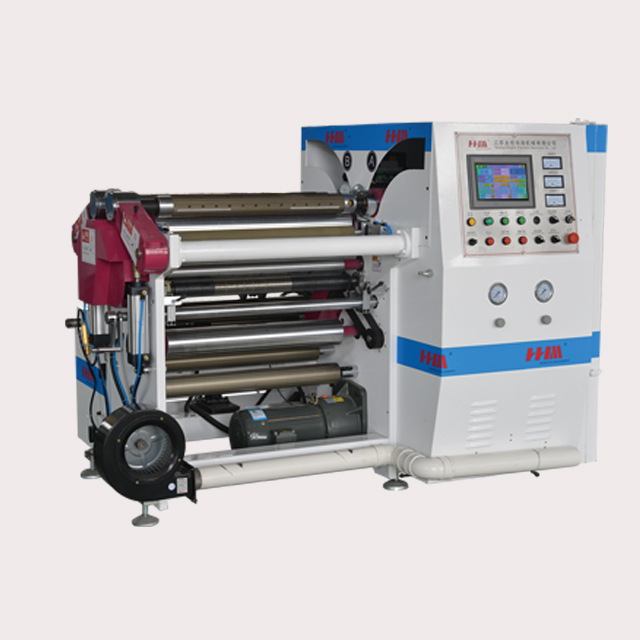
Investing in specialized converting equipment requires a deep understanding of the physical challenges occurring on the shop floor. When a web of material is sliced into 3mm increments, the margin for error shrinks to microscopic levels.
Web wandering refers to the lateral movement of the material as it travels through the machine. Consider cutting a 100mm roll. A 0.5mm lateral shift is a 0.5 percent deviation, which might be acceptable depending on your tolerance. In contrast, when cutting a 3mm strip, that same 0.5mm shift represents a catastrophic 17 percent deviation. This severe misalignment causes the strip to snap, fray, or become entirely unusable for downstream automation.
One of the most common issues operators face is the spaghetti effect. As the web exits the cutting station, dozens of flimsy 3mm ribbons suddenly lose their collective structural integrity. Without immediate and precise handling, they begin to sway, twist, and intertwine like cooked pasta. Controlling these individual strands requires flawless web handling and exact distance control between the cutting station and the rewinder.
Master rolls are rarely perfect. They often contain microscopic thickness variations across their width. In wide slitting, this is easily manageable. However, in ultra-narrow applications, these minor thickness variations become heavily magnified. If a 3mm strip is slightly thicker on one side, it creates a camber. This curvature causes the roll to become unstable as it rewinds over hundreds of meters, leading to telescoping or total roll collapse.
Achieving a perfect 3mm cut is not about operator skill. It is entirely about mechanical and electronic precision. The accuracy of the finished product relies on a synchronized system of advanced components working in unison.
Before the material even reaches the blades, it must be perfectly aligned. Edge Position Control and Line Position Control systems utilize highly sensitive photoelectric or ultrasonic sensors. These sensors monitor the edge or a printed line on the master roll. They communicate with a linear actuator that physically shifts the unwind stand to correct deviations. To succeed in ultra-narrow slitting, these guiding systems must operate with millisecond reaction times and sub-millimeter accuracy.
Tension control is the heartbeat of a precision slitting machine. If the tension is too high, the fragile strips will yield, stretch, or snap. Conversely, insufficient tension causes catastrophic sagging. High-end equipment utilizes closed-loop servo systems and ultra-sensitive load cells. These sensors continuously measure the exact tension of the web and feed data back to a programmable logic controller. The system then makes micro-adjustments to the magnetic powder brakes on the unwind stand or the servo motors on the rewind shafts. This ensures the ultra-low tension required remains perfectly stable from the core to the maximum rewind diameter.
The cutting mechanism must be carefully selected based on the material properties. Razor cutting is highly cost-effective and provides clean cuts for delicate, flexible plastic films. Shear cutting utilizes a top and bottom rotary blade acting like a pair of scissors. This method is strictly required for thicker materials, papers, and metal foils to ensure a clean, burr-free edge.
To achieve exactly 3mm, the spacing between these blades must be absolute. Precision ground spacers, machined to extreme tolerances, are used to separate the knives. Customized knife holders are deployed to eliminate any microscopic blade wobble during high-speed rotation.
Standard air shafts inflate to lock all rewind cores in place. This means all rolls turn at the exact same speed and torque. This legacy method fails spectacularly in narrow slitting due to the thickness variations mentioned earlier. Differential friction shafts, also known as slip shafts, solve this dilemma.
They consist of multiple independent friction rings. As the shaft rotates, pneumatic pressure is applied to these rings. If one 3mm strip is slightly thicker and winds tighter, its specific friction ring will slip slightly. This reduces the tension on that individual roll while maintaining proper tension on the adjacent rolls. This brilliant mechanical compensation ensures every single 3mm roll on the shaft has the exact same tightness and diameter.
Achieving a precise cut is not a one-size-fits-all process. The physical properties of the master roll dictate exactly how a 3mm slitting machine must be calibrated. An optimal setup for delicate plastic films will cause disastrous results if applied to rigid metal foils.
When processing flexible polymers like biaxially oriented polypropylene, PET, or PVC, the primary engineering concerns are material stretching and static electricity accumulation. As a master web is divided into tiny strips, the tensile strength of each strip drops dramatically. Running a 12-micron film without proper tension calibration inevitably leads to stretching. This defect, known as necking, narrows the 3mm strip down to 2.8mm, rendering it out of specification.
To counteract this, the machine must utilize active static elimination bars positioned immediately after the cutting section. This neutralizes the web before it reaches the rewind shafts, preventing the lightweight strips from clinging to the rollers.
Slitting metal foils for lithium-ion battery manufacturing introduces entirely different mechanical challenges. Metals do not stretch easily. Instead, they are prone to burring, edge deformation, and micro-cracking if the cutting parameters are incorrect.
For these rigid materials, razor cutting is highly ineffective. The machine must be equipped with a robust rotary shear cutting system. The precision relies heavily on the blade overlap and the shear angle of the top and bottom circular knives. Advanced equipment designed for metal processing features micrometer-adjustable knife holders to maintain exact blade clearance.
Paper and non-woven textiles present the unique challenge of dust generation and edge fraying. When slitting paper to a 3mm width, the interlocking fibers are violently severed, releasing microscopic airborne particles. A specialized slitter handling these materials must integrate a high-velocity vacuum dust extraction system directly at the slitting interface. Precise paper strips generally require shear cutting with highly polished, hardened steel blades to ensure a sharp edge without tearing the fragile fiber structure.
Even minor deviations in the slitting process are magnified when dealing with ultra-narrow widths. Below is an engineering breakdown of the most common defects encountered on the shop floor and the specific mechanical interventions required to resolve them.
Defect Type | Visual Symptom | Root Cause Analysis | Machine-Level Solution |
|---|---|---|---|
Telescoping | The rewound roll looks like a cone with layers sliding laterally. | Entrapped air between layers or an incorrect tension taper profile as the roll diameter increases. | Implement precision lay-on rollers to squeeze out air. The controller must execute a strict taper tension profile, gradually reducing tension as the roll grows. |
Interweaving | Adjacent strips tangle or overlap before reaching the rewind shaft. | Web wandering due to poor guiding, or the physical distance between the blades and the rewind shaft is too long. | Shorten the web path length. Utilize custom grooved spreader rollers to maintain physical separation between strips. |
Burred Edges | The edge of the strip feels rough, sharp, or exhibits micro-tears. | Dull blades, incorrect blade clearance, or improper over-speed ratio of the bottom shear blade. | Establish strict blade sharpening schedules. Adjust the bottom anvil roller to run slightly faster than the web speed to ensure a clean shear. |
Camber Bowing | The 3mm strip curves like a banana when laid flat on a table. | Thickness variations in the master roll causing uneven tension distribution across the web. | Deploy differential friction shafts. These allow individual slip rings to rotate independently, automatically compensating for thickness variations. |
Procuring equipment for ultra-narrow applications requires a stringent evaluation of the machine architecture. Off-the-shelf standard slitters retrofitted with narrow blade spacers will inevitably fail. Procurement teams and process engineers should mandate the following specifications.
Micro-vibrations are the absolute enemy of accuracy. If the machine frame is constructed from lightweight sheet metal, the rotational forces of the shafts will induce resonance. This high-frequency vibration transfers directly to the slitting blades, causing them to oscillate. The result is a wavy cut and compromised edge quality. A true precision slitter must be built upon a heavy-duty, solid cast iron or thick-plate steel chassis. The sheer mass dampens kinetic vibrations, providing a rigid foundation.
Managing dozens of 3mm strips simultaneously means manual tension adjustments are no longer viable. Operators simply cannot react fast enough. Look for equipment featuring industrial-grade programmable logic controllers paired with intuitive touchscreen interfaces. High-end center surface slitting machines typically support unwind diameters up to 600mm and rewind diameters up to 400mm while maintaining exact tension control. This digital infrastructure allows engineers to create and save specific tension recipes for different materials, removing operator guesswork.
Because ultra-narrow slitting serves specialized industries, standard configurations rarely suffice. Buyers must look for manufacturers capable of deep engineering customization. This includes custom-machined knife blocks, specialized grooved rollers tailored to the exact width of the product, and bespoke differential shaft setups. The ability to customize the web path and apply surface treatments, such as plasma coating for non-stick applications, is a critical indicator of a top-tier machinery builder.
Capital expenditure on specialized converting equipment is significant. However, the return on investment can be rapidly realized through three primary operational efficiencies.
First, the reduction in material scrap is profound. When a standard machine attempts to cut narrow widths, edge trim waste and rejected rolls can easily exceed 15 percent of the master roll. A purpose-built machine utilizes differential shafts and precise web guiding to drive scrap rates down to low single digits. For high-value materials like battery separators, this material savings alone justifies the machine cost within the first year.
Second, advanced machines offer higher running speeds without compromising accuracy. Traditional slitters must be slowed down to a crawl to prevent strips from snapping. In contrast, specialized equipment equipped with closed-loop servo control maintains perfect tension stability at high velocities, often reaching speeds of 200 to 300 meters per minute. This drastically improves overall equipment effectiveness.
Finally, modern precision slitters reduce costly machine downtime. Features such as automated knife positioning systems and cantilevered shaft designs for rapid roll unloading minimize changeover times. By reducing the hours spent on manual setup, manufacturers maximize their active production hours.
Accurate 3mm slitting requires a perfectly orchestrated balance of tension control, blade precision, and specialized rewinding technology. Standard slitters simply cannot handle this narrow task. Attempting to use them will only lead to wasted material, high scrap rates, and operator frustration.
By investing in properly engineered equipment featuring differential friction shafts, robust vibration dampening, and automated closed-loop tension systems, manufacturers guarantee consistent, micrometer-level quality. If your production line is struggling with ultra-narrow cuts, it is time to upgrade your capabilities. We encourage you to visit HHMMach to explore a complete range of specialized slitting equipment and find the exact machine configuration tailored to your specific material properties.
While standard converting machines begin to produce defects at widths below 10mm, a high-quality precision slitter accurately cuts materials down to 3mm. In highly controlled environments with specific materials featuring high tensile strength, specialized machines can even achieve stable cuts down to 2mm. The absolute minimum width is ultimately dictated by the material ability to withstand rewind tension without snapping.
Master rolls possess microscopic thickness variations across their width. When slitting a web into dozens of narrow strips, these minute variations compound. Thicker strips wind faster and tighter, while thinner strips wind loosely and sag. A differential friction shaft utilizes independent slip rings that allow each individual roll to slip at its own rate. This mechanical compensation ensures that every single roll maintains the exact same uniform tension.
The optimal cutting method depends entirely on the material matrix. Razor cutting is typically the best and most cost-effective method for thin, flexible plastic films. Conversely, shear cutting is mandatory for thicker papers, rigid metal foils, and complex laminates to ensure a clean, burr-free edge without crushing the material.
Preventing this effect requires a combination of mechanical strategies. The most critical factor is keeping the web path distance between the slitting blades and the rewind shafts as short as physically possible. Utilizing grooved spreader rollers helps maintain physical separation between the strips, while flawless closed-loop tension control prevents the strips from wandering laterally before they are securely wound onto the cores.
Running speed depends heavily on the tensile strength of the material being processed. However, top-tier slitting machines equipped with advanced servo motors and closed-loop tension control can comfortably maintain speeds between 200 and 300 meters per minute without compromising the 3mm width accuracy or causing web breaks.
Processing delicate films at ultra-narrow widths requires a fully automated, closed-loop tension control system. This setup must include ultra-sensitive load cells to constantly monitor web tension and a programmable logic controller that makes millisecond adjustments to servo-driven rewind shafts. This guarantees the tension remains perfectly tapered as the roll diameter increases.
