
Views: 0 Author: Site Editor Publish Time: 2026-10-21 Origin: Site
Are web breaks ruining your roll quality? Choosing the wrong machine inevitably causes massive material waste. It eats directly into profit margins. In the highly competitive converting sector, you need the exact right winding technology to guarantee production efficiency.
We will break down the mechanics, advantages, and ideal applications of the two dominant winding systems. You will know exactly which technology fits your specific material substrate and operational demands.
Center surface winding combines center drive torque with surface nip pressure. This makes it the optimal mechanical choice for heavy rolls, extensible materials, and large-diameter outputs.
Friction shaft rewinding, commonly known as differential winding, utilizes independent slip rings to compensate for uneven material thickness across the web. It is strictly necessary for sensitive plastic films and foils.
The decision to invest in either a center surface machine or a friction-based system depends entirely on empirical data. You must evaluate your specific material substrate, required web tension profiles, and expected roll weight.
Selecting the correct winding technology drastically reduces material waste. It mitigates roll defects like telescoping and ensures seamless downstream processing.
In the web converting industry, the finishing process dictates the final quality of the product delivered to the end-user. The primary equipment responsible for this critical phase is the slitter rewinder. This machine takes a master roll from the extrusion or paper-making process and cuts it into narrower, manageable rolls tailored for packaging, printing, or lamination. Master rolls are often wide, heavy, and imperfectly wound.
However, slitting the material is only half the mechanical equation. The true engineering challenge lies in the rewinding phase. Imagine an operator standing on a noisy factory floor, watching thousands of meters of film fly through the blades. If the rewind tension is not flawless, that entire master roll becomes expensive scrap in seconds.
Web handling is governed by strict physical principles. As a material travels through a machine, it must maintain a specific tension profile. If the tension drops too low, the web sags. This leads to wrinkles, poor slit quality, and lateral shifting known as telescoping. Conversely, if the tension spikes too high, the material stretches beyond its yield point. This results in web breaks, crushed cores, or a severe defect known as starring, where the inner layers of a roll collapse under the compressive force of the outer layers.
A modern converting machine must handle varying material profiles seamlessly. Materials simply do not behave uniformly. A thick, porous roll of cardboard interacts with tension entirely differently than a thin, slippery sheet of Polyethylene Terephthalate. To achieve a perfect roll with uniform density, straight edges, and zero internal stress, manufacturers must perfectly match the winding technology to the substrate.
This system represents a robust, highly stable approach to web rewinding. Engineered to handle substantial weight and high-speed operations, it distributes the mechanical workload between two distinct driving forces.
Understanding this machinery requires looking at its dual-action mechanics. The rewinding roll is driven by a center shaft, which provides the necessary rotational torque. Simultaneously, a driven surface roller, often called a lay-on roller or surface drum, applies direct pneumatic or hydraulic pressure to the outside diameter of the winding roll.
This combination of center torque and surface pressure allows the machine to create a perfect taper tension profile. Taper tension means the roll is wound tightly at the core and gradually wound with less tension as the diameter increases. The center drive controls the web tension. Meanwhile, the surface drum controls the nip pressure. From a practical standpoint, this nip pressure forces trapped air out from between the material layers. It increases the coefficient of friction between the wraps and locks them solidly in place.
Exceptional Load Capacity: Supporting the roll at both the core and the surface provides a distinct structural advantage. It allows the machine to wind massive, large-diameter rolls that would otherwise cause a standard shaft to deflect or bend under sheer tonnage.
Air Entrapment Prevention: High-speed winding naturally pulls ambient air into the roll. For non-porous materials, trapped air acts as a lubricant, causing the layers to slide. The continuous, heavy squeeze of the surface drum effectively pushes this air out.
Stability for Extensible Materials: Materials that stretch easily, like certain non-wovens or textiles, benefit immensely. The web is supported by the drum right up to the exact point it joins the roll. This minimizes the distance it is subjected to unsupported, free-span tension.
While highly efficient for heavy-duty applications, brute stability is not universally applicable. The primary mechanical limitation surfaces when dealing with materials that exhibit severe gauge variations across the width of the web.
Because the heavy surface drum applies uniform pressure across the entire width of the machine, it assumes the material is perfectly flat. If one section of the web is microscopically thicker than the rest, that section will build up into a larger diameter faster than the thinner sections. The rigid surface drum will press heavily on the thicker roll, potentially damaging it. At the same time, it fails to apply adequate pressure to the thinner rolls, causing them to wind loosely.
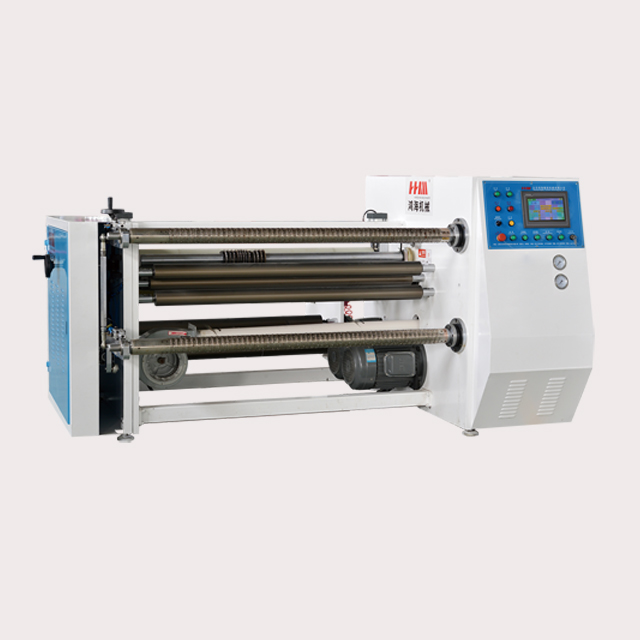
When dealing with high-value, sensitive, or structurally uneven substrates, the mechanical paradigm must shift from rigid stability to independent adaptability. In these scenarios, deploying a friction shaft slitting machine becomes an absolute operational necessity.
Technically known as differential winding, this method abandons the solid, locked shaft approach. Instead, a differential rewind shaft is equipped with dozens of independent friction rings lined up across its length.
During operation, the central core of the shaft over-speeds, rotating slightly faster than the actual winding speed of the rolls. Pneumatic pressure is applied internally within the shaft. This expands friction elements that press against the inside of the slip rings to create a specific amount of drag.
When a wide web of BOPP film enters the nip, you can actually see the engineering at work. Because each slip ring rotates independently, it automatically compensates for gauge variations. If a thicker area of the web causes one roll to grow slightly larger, that roll will naturally pull more tension. The friction ring detects this increased resistance and slips. It slows down its rotation to equalize the tension with the smaller, thinner rolls right next to it.
Furthermore, modern industrial equipment has elevated this technology. For instance, a high-configuration center friction shaft slitting machine can easily handle web widths up to 1450mm and operate at sustained speeds of 500 meters per minute. By utilizing closed-loop tension control systems, these machines dynamically adjust the pneumatic pressure across 3-inch or 6-inch slip rings in real-time, ensuring absolute precision.
Perfect Independent Tension Control: The standout benefit is the ability to maintain uniform tension across multiple slit rolls on the exact same shaft, regardless of microscopic differences in their outer diameters.
Elimination of Web Breaks and Sagging: By preventing the dreaded tight edge and baggy edge phenomenon, the differential slip ensures that thicker rolls do not snap the web, and thinner rolls do not droop and lose winding integrity.
Protection of Delicate Substrates: High-value materials cannot tolerate tension spikes. The slipping action acts as a mechanical shock absorber, protecting the substrate from stress-induced deformation.
The sophisticated nature of differential winding introduces specific operational constraints. The continuous slipping action inherently generates friction, which in turn creates heat and microscopic dust. Consequently, friction rings require strict, regular maintenance. Operators must clean them frequently to avoid dust buildup. Dust alters the coefficient of friction and ruins tension accuracy. In addition, because the rolls rely on internal friction rather than a solid mechanical lock, these systems generally have strict weight limitations and cannot support the massive tonnage seen in paper mills.
To assist plant managers and engineers in making data-driven equipment decisions, it is critical to compare these two technologies across key operational metrics.
The fundamental difference lies in how tension is distributed. A center surface system utilizes fixed-shaft tension combined with external nip pressure, applying force uniformly across the entire web width. It relies heavily on the assumption that the material is flawless.
In contrast, a friction shaft system utilizes independent slip-tension. It assumes the material is flawed and actively compensates for those imperfections. If a converter is running a master roll with known profile defects, differential winding is often the only way to salvage the material into perfectly tensioned finished rolls.
In the real world of converting, extruded films rarely possess a perfectly uniform thickness. A variance of just 1 or 2 microns, when multiplied by thousands of wraps around a core, results in significant diameter discrepancies. When handling these variations, friction shafts win unequivocally. The differential slip of the friction rings absorbs diameter differences seamlessly. A solid shaft would tear the tighter rolls and leave the thinner rolls baggy.
When raw throughput and heavy-duty processing are the primary goals, center surface winders excel. The mechanical integrity of a solid driven shaft, supported by a heavy steel surface drum, allows these machines to run at blistering speeds while supporting rolls weighing several tons.
Friction shafts are limited by the thermal capacity of their slip rings. Excessive weight or extreme speeds can cause the internal friction pads to overheat. This leads to premature wear or a complete loss of tension control. Thus, they are reserved for lighter rolls and moderate to high precision speeds.
Capital expenditure and ongoing maintenance costs differ significantly. Center surface machines are structurally robust. They require minimal routine maintenance beyond standard bearing lubrication and pneumatic checks. They offer a lower total cost of ownership over a long lifecycle in heavy-industry settings.
Friction shaft systems are precision instruments. The slip rings contain internal bladders, friction pads, and ball locks that wear down over time due to constant slipping. They demand a highly dust-controlled facility and regular replacement of wear parts, resulting in higher ongoing operational costs.
Feature / Metric | Center Surface Winding | Friction Shaft Rewinding |
|---|---|---|
Primary Drive Mechanism | Center torque + Surface nip pressure | Central shaft with independent slip rings |
Tension Distribution | Uniform across the entire web width | Independent for each individual slit roll |
Tolerance for Gauge Variation | Very Low | Very High |
Roll Weight Capacity | Extremely High | Moderate to Low |
Air Entrapment Prevention | Excellent | Moderate |
Maintenance Requirements | Low | High |
Recent industry analyses indicate a massive push toward sustainable, down-gauged packaging materials and advanced energy components across the global converting sector. As consumer brands demand thinner, recyclable mono-material films to meet strict environmental mandates, converters face a unique operational hurdle.
Thinner substrates are exponentially more sensitive to tension spikes and gauge bands. For example, processing 9-micron PET films or 6-micron copper foils for electric vehicle batteries requires absolute tension isolation. A thickness variance of just half a micron across a wide web creates massive diameter discrepancies on the rewind shaft. This macro-trend is driving a marked increase in the adoption of differential winding technologies. Legacy solid-shaft systems simply crush or stretch these delicate materials. Advanced friction shafts provide the micro-tension adjustments necessary to process next-generation eco-friendly films without catastrophic yield loss.
Selecting the appropriate winding technology should never be based on initial capital expenditure alone. It requires a methodical evaluation of material science and long-term production objectives. Use these direct matching criteria for your factory floor.
You are processing kraft paper, heavy cardboard, or thick non-wovens.
Your primary goal is producing massive, large-diameter rolls for secondary downstream processing.
The material has a highly uniform thickness profile with minimal gauge variation.
You are slitting adhesive tapes or labels where extreme surface pressure is required to prevent telescoping.
You are processing BOPP, PET, PVC, PE films, or flexible packaging laminates.
You are slitting high-value aluminum or copper foils for battery manufacturing.
The master roll has known gauge bands or microscopic thickness inconsistencies.
You need to slit a wide web into multiple, narrow finished rolls on a single shaft.
Choosing between winding systems comes down to a precise understanding of your materials. Heavy, uniform substrates thrive on the brute stability of a center surface slitting machine. Delicate, uneven films demand the nuanced, independent control of a friction shaft slitting machine. By aligning the mechanical capabilities of the equipment with the physical properties of your web, you eliminate recurring defects and elevate your entire production line profitability.
Stop letting gauge variations and improper tension control dictate your scrap rates. Partnering with a specialized manufacturer ensures your drive mechanics align perfectly with your material. Explore the comprehensive range of converting solutions at HHM Machinery to find the exact slitting equipment tailored for your production floor.
The primary advantage lies in its ability to handle very heavy, large-diameter rolls and highly extensible materials with exceptional stability. It achieves this by combining center drive torque with surface nip pressure. The surface drum physically contacts the rewinding roll. It actively expels air that would otherwise become trapped between the material layers. This prevents roll slippage, telescoping, and starring, ensuring the finished roll is dense and structurally sound.
A friction shaft prevents web breaks by allowing individual rolls on the same shaft to slip at different, independent rates. When microscopic variations in material thickness cause some rolls to build up a larger diameter, those larger rolls naturally pull the web tighter. The internal pneumatic slip rings detect this tension increase and slip against the central core, equalizing the tension across the entire web. This guarantees that thicker rolls do not snap the material and thinner rolls do not lose tension.
Telescoping occurs when the layers of a rewinding roll slide laterally, creating a cone or telescope shape. It is primarily caused by inadequate web tension, trapped air between layers, or a misalignment in the web path. To fix it, engineers must adjust the taper tension profile. For non-porous materials, increasing the nip pressure of a lay-on roller helps squeeze out trapped air, locking the layers firmly together.
Maintenance frequency depends heavily on the operating environment and machine speed. In a standard converting facility, friction rings should be inspected and blown clean of dust weekly. Because they rely on controlled slipping, dust buildup drastically alters their coefficient of friction, leading to erratic tension. The internal friction pads or bladders typically require replacement every 12 to 18 months, depending on wear and tear.
Yes, highly advanced duplex slitter rewinders can be engineered to feature hybrid winding systems. These specialized machines are designed for maximum operational flexibility. Some models allow operators to physically swap out solid center-surface shafts for differential friction shafts depending on the production run. Others integrate surface lay-on rollers directly against differential friction shafts. However, these dual-capability machines require a significantly higher initial capital investment.
A friction shaft slitting machine is universally superior for processing plastic films such as BOPP, PET, PVC, and flexible packaging laminates. The extrusion process used to manufacture plastic films inherently creates slight thickness variations known as gauge bands. A standard solid shaft cannot compensate for these varying diameters, leading to immediate tension failures. The differential slip capability of a friction shaft is specifically engineered to counteract these exact gauge variations.
