
Views: 0 Author: Site Editor Publish Time: 2026-10-21 Origin: Site
Slitting adhesive tapes down to micro-widths like 3 mm presents an extreme manufacturing challenge. It routinely tests the patience of even the most experienced machine operators. Anyone who has stood on a production floor knows the common frustrations. You see a master roll destroyed by severe adhesive oozing. Webs snap mid-run. Finished rolls telescope into unusable cone shapes. The physical dynamics of the tape change drastically when the width-to-thickness ratio decreases. Standard converting protocols become completely ineffective.
Whether a production line processes delicate paper masking tapes or heavy-duty acrylic foam tapes, precision is non-negotiable. Achieving flawless 3mm rolls requires a perfect synergy of three critical elements: correct blade choice, highly precise web tension control, and superior edge quality management. In practice, these variables demand specialized equipment. A 3mm narrow slitter rewinder engineered specifically for micro-width converting provides the necessary control. This guide explores the empirical data, mechanical principles, and operational realities behind mastering the 3mm cut.
Blade Selection is Critical: Employing razor or shear blades with anti-stick coatings like Teflon or titanium minimizes adhesive buildup. This ensures clean cuts without dragging the substrate.
Tension Dictates Quality: Micro-width tapes possess minimal tensile strength. They require sensitive closed-loop web tension control to prevent material stretching or roll telescoping.
Machine Type Matters: Utilizing center surface rewinding technology provides the mechanical support needed to prevent fragile 3mm rolls from collapsing.
Material Variables: Tape thickness and viscoelastic adhesive strength directly dictate your optimal machine settings.
The converting industry is experiencing a profound shift. This transformation is heavily driven by the rapid miniaturization of consumer electronics, intricate medical devices, and electric vehicle battery components. Recent market analyses highlight a critical new reality. OEMs now demand micro-width tapes with absolute zero-tolerance for edge defects or dimensional variations. Consequently, traditional converters find that retrofitting older wide-web machines fails to meet these rigorous standards.
Instead, the market is accelerating toward specialized highly automated slitting architectures. Facilities are investing in equipment featuring automated knife positioning, ultrasonic web guiding, and AI-assisted tension monitoring systems. These advanced setups preemptively adjust to material inconsistencies. Relying on outdated manual machinery for micro-slitting is rapidly becoming obsolete in today's quality-driven landscape.
Standard slitting operations typically handle widths of 12 mm, 24 mm, or 50 mm. At these dimensions, the tape roll retains enough structural integrity to support itself. However, reducing the width to a mere 3 mm fundamentally alters the structural stability of the finished roll. It also amplifies the physical stresses applied to the tape during the cut.
Different adhesive materials behave uniquely under slitting pressure. High-strength products like heavy-duty acrylic foam tapes possess highly cohesive adhesives that naturally resist separation. Picture a 3mm wide strip of high-tack acrylic tape. As the blade attempts to sever it, the adhesive tends to stretch and transfer onto the metal rather than parting cleanly. Conversely, lower-tack tapes with fragile backings are highly prone to backing fracture if the cutting pressure is even slightly excessive. Material thickness directly alters the cutting dynamic. Thicker materials require a wider blade separation angle. This geometry can easily distort a narrow 3mm strip if not meticulously managed.
Adhesive oozing is a primary failure mode in narrow web slitting. Shop floor operators often refer to this as cold flow. When mechanical pressure is applied to a 3mm width during the rewinding process, the viscoelastic adhesive compresses. Because there is minimal surface area to distribute this pressure, the adhesive escapes laterally through the edges. This oozing effectively glues the layers of the finished roll together. Furthermore, if the rewinding tension profile fluctuates, the 3mm roll lacks the lateral friction required to stay aligned. This instability results in telescoping. The roll layers slide outward into a cone shape, leading to immediate quality control rejection.
The cutting mechanism represents the primary interaction point between the machinery and the raw material. Selecting the appropriate cutting technology and blade geometry is the foundational step in achieving a premium edge profile without constant machine stoppages.
The two dominant methods for converting adhesive tapes are razor slitting and shear slitting. Razor slitting relies on a single stationary blade to slice through the moving web. This approach is highly effective for thin films and lightweight tapes because it displaces very little material. It is ideal for maintaining the exact dimensional accuracy of a 3mm cut.
In contrast, shear slitting operates much like a pair of scissors. It utilizes a rotating top and bottom circular blade to provide a significantly more aggressive shearing force. This method is the mandatory choice for thicker substrates like double-sided foam tapes that would quickly deflect a standard razor blade.
Regardless of the chosen slitting method, adhesive transfer to the blade is inevitable without proper mitigation. Operators often find themselves halting production to clean sticky residue off standard steel blades. As adhesive builds up on the knife, it creates friction. This drags the 3mm web and severely frays the edges. Coated blades treated with ceramic, titanium nitride, or Teflon are essential to combat this issue. These anti-stick coatings significantly lower the coefficient of friction. Additionally, a highly acute blade angle minimizes outward pressure on the 3mm strip. This geometry dramatically reduces the likelihood of adhesive squeezing out during the initial cut.
Tape Material Type | Recommended Blade Type | Coating Requirement | Edge Quality Impact |
|---|---|---|---|
Thin PET / BOPP Tapes | Industrial Razor | Teflon / Ceramic | Excellent flush edge, zero displacement |
Paper Masking Tapes | Razor or Light Shear | Titanium Nitride | Prevents paper fiber crushing |
Heavy-Duty Foam / VHB | Driven Shear Blades | Micro-mist Lubrication | Handles cohesive strength without snapping |
Double-Sided Tissue | Shear Blades | Teflon | Minimizes adhesive transfer between layers |
Tension is the invisible force governing the success or failure of a narrow slitting operation. At a width of 3 mm, the tensile strength of the tape approaches zero. Relying on standard tension parameters will instantly cause catastrophic material failure.
The journey of the web requires absolute synchronization between the unwind and rewind zones. Unwind tension must be precisely calibrated to keep the tape perfectly flat before it hits the blade section. If the unwind tension is too loose, the web flutters. This causes the 3mm cuts to wander and vary in width. If it is too tight, the material stretches and alters the adhesive properties permanently.
This delicate balance is best achieved using a high-precision narrow tape slitting machine equipped with closed-loop tension controllers. Advanced systems continuously monitor and adjust the braking force based on the real-time diameter of the unwinding master roll.
To prevent fragile 3mm tape from snapping, modern equipment utilizes advanced load cells and low-inertia dancer rollers. These components absorb micro-fluctuations and mechanical shocks. More importantly, the system must employ a taper tension profile during the rewind phase. Taper tension gradually decreases the rewinding torque as the finished roll grows in diameter. Without this gradual reduction, the outer layers exert massive radial pressure on the inner layers. This crushes the core and forces the adhesive to bleed out.
For end-users in precision sectors like electronics assembly or medical wearables, edge quality is the ultimate metric of reliability. A compromised sticky edge inevitably leads to automated dispensing failures on high-speed assembly lines.
A premium edge is flush, non-sticky to the touch, and perfectly cylindrical. Achieving this requires the total elimination of lateral blade movement. Even a microscopic wobble in the blade holder creates a serrated edge on a 3mm tape. This irregular cut exposes more adhesive surface area and actively promotes bleeding. Maintaining razor-sharp blades and utilizing micro-adjustable blade holders ensures the cut is clean.
Precision at the micro-level demands strict mechanical tolerances. At a 3mm width, a machine vibration of just one millimeter represents a massive 33% deviation in product width. Therefore, eliminating kinetic vibration is critical. Heavy-duty cast-iron or thick steel machine frames absorb operational shocks effectively. Precision machining of the differential friction shafts ensures rotation remains perfectly concentric. This prevents the 3mm rolls from oscillating as they build.
Standard center-winding machines rely entirely on the tension of the web to build the roll structure. While perfectly sufficient for wide rolls, applying this logic to 3mm rolls is a recipe for disaster. The inherent structural instability of a micro-roll requires external mechanical support during the high-speed rewind phase.
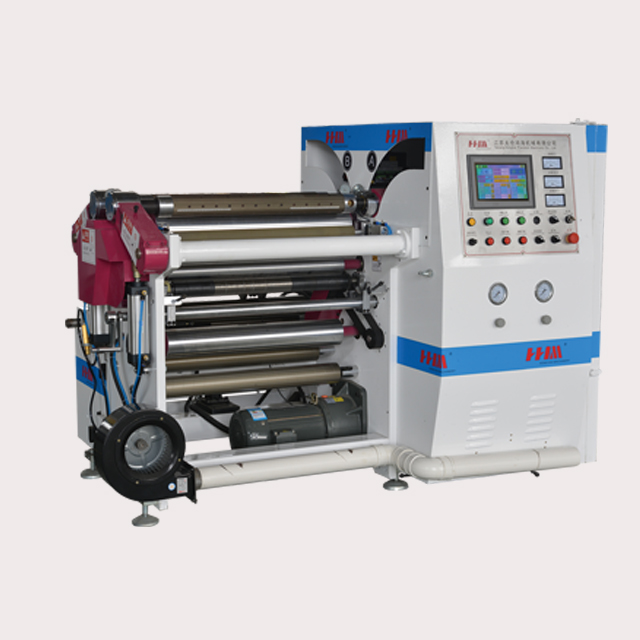
A specialized center surface slitting machine fundamentally solves the instability problem by combining two distinct driving forces. The center differential shaft provides the rotational torque to wind the tape. Simultaneously, a secondary full-width surface lay-on roller physically rests against the outside diameter of the slit rolls as they build.
For instance, high-performance equipment like the HH650E series integrates highly sensitive pneumatic controls for the surface roller. Operators can precisely dial in the contact pressure. The presence of the surface lay-on roller provides a game-changing advantage. First, it acts as a dynamic physical barrier preventing the 3mm rolls from falling over or leaning. Second, the regulated pressure actively expels trapped air between the layers of tape. By removing this air, the machine guarantees the micro-rolls are perfectly dense and stable from the core to the outer diameter.
Adhesives possess vastly different chemical compositions and physical structures. Standardizing a single machine setting for all materials is impossible. Operators must intelligently adapt their processes based on the specific substrate.
Thick foam tapes feature highly cohesive acrylic adhesives. When slitting these dense materials down to 3mm, the adhesive frequently attempts to weld itself back together immediately after the blade passes. To combat this phenomenon, operators must utilize specific blade lubricants like micro-mist silicone systems. Applying controlled heat to shear blades temporarily reduces adhesive viscosity at the exact point of the cut. This allows the blade to glide through without cohesive resistance.
Conversely, paper-backed tapes require a much more delicate touch. The paper backing is highly susceptible to tearing under tension. When processing masking tapes to 3mm, unwind tension must be kept exceptionally low. Razor slitting is typically preferred over shear slitting to prevent crushing the delicate paper fibers. Furthermore, lay-on roller pressure must be carefully minimized to avoid compressing the crepe paper texture.
Even the most technologically advanced machinery will produce defective 3mm rolls if routine maintenance protocols are ignored. Mechanical tolerances at this micro-width are extremely tight. Minor equipment degradation quickly cascades into major production failures.
Adhesive residue acts as a harsh abrasive. If left on the blades, it rapidly dulls the cutting edge and causes the tape to drag. Production managers must establish strict blade cleaning schedules using approved non-corrosive solvents. Because a dull blade immediately causes adhesive oozing on a 3mm roll, replacement schedules should be based on linear meters processed rather than visual defects.
The differential friction shafts serve as the heart of the rewind tension system. Over time, internal friction rings accumulate paper dust or wear down. This leads to inconsistent torque across the web. Routine pneumatic calibration of the tension controllers and thorough cleaning of the friction rings are mandatory. This upkeep ensures the machine maintains factory-level precision shift after shift.
Successfully cutting 3mm adhesive tape requires the perfect blade geometry, exact tension management, and the right machinery to guarantee pristine edge quality. While the material properties of thick foams or delicate papers pose inherent challenges, adopting advanced center-surface rewinding technology neutralizes these obstacles. Upgrading your production capabilities is the definitive step toward eliminating adhesive bleed and stopping roll telescoping. To explore equipment engineered specifically for these exacting tolerances, review the high-performance solutions available through HH Mach and select the ideal configuration for your manufacturing line.
It heavily depends on the specific tape material. Razor slitting with Teflon-coated or ceramic blades is generally best for thin films to prevent adhesive sticking and minimize displacement. In contrast, robust shear blades are required for thicker foam or heavy-duty acrylic tapes to provide the necessary cutting force without deflecting.
This common defect is usually caused by a dull cutting blade, an incorrect blade entry angle, or excessive rewind tension. When tension is too high, it physically squeezes the viscoelastic adhesive out of the sides of the narrow 3mm roll as it builds on the shaft.
It is specialized equipment that rewinds the material by driving the center shaft while a surface lay-on roller applies consistent pneumatic pressure to the outside of the roll. It is absolutely essential for 3mm tapes because it provides the physical support needed to prevent extremely narrow rolls from collapsing, leaning, or telescoping during the high-speed rewind process.
Usually, no. Standard machines lack the ultra-sensitive micro-tension control, heavy-duty vibration stability, and specialized differential friction shafts required for such precise work. A dedicated narrow tape slitting machine is required to handle the extreme fragility and aggressive adhesive nature of 3mm cuts.
Web snapping is a direct result of improper tension control. To resolve this, ensure your machine utilizes closed-loop taper tension. This system automatically decreases the rewinding torque as the roll grows. Additionally, employing low-inertia dancer rollers helps absorb mechanical shocks that would otherwise break a fragile 3mm web.
While standard slitters struggle below 12mm, high-precision center surface machines equipped with differential friction shafts and micro-adjustable blade holders can reliably process tapes down to 2mm or 3mm. The key is the dynamic support provided by the surface lay-on roller, which keeps these micro-rolls stable at high speeds.
