
Views: 0 Author: Site Editor Publish Time: 2026-10-24 Origin: Site
Have you ever stood on a noisy factory floor and watched a 1,000-kilogram, 1.3-meter-wide roll of tape being processed? It is a demanding environment. Transforming these massive, unwieldy cylinders into the perfectly wound, two-inch retail sizes we use daily requires a staggering level of mechanical precision.
In this guide, we break down the exact slitting and rewinding workflow. You will see how raw materials are handled and how modern machinery eliminates material waste. More importantly, we will explore the specific engineering marvels that keep the packaging industry moving at lightning speed.
Key Takeaways
Transforming a jumbo master roll into consumer-ready tape relies on three synchronized stages: precise unwinding, razor-sharp slitting, and tension-controlled rewinding.
Upgrading to a high-quality converting setup directly boosts daily production speed, finished roll clarity, and material waste reduction.
Modern slitting lines utilize advanced Programmable Logic Controllers and closed-loop tension management systems. These handle highly sensitive adhesive substrates without stretching them.
Selecting the right machinery demands a careful evaluation of web width, drive systems, shaft configurations, and automated labor-saving capabilities.
At its core, this is specialized industrial converting equipment. It is designed to cut exceptionally wide master rolls of Biaxially Oriented Polypropylene tape into multiple narrower strips. On the factory floor, we universally refer to these as jumbo rolls. BOPP film remains the undisputed standard substrate for global packaging tape. It offers high tensile strength, excellent moisture resistance, and optical clarity.
However, converting a massive master roll into the standard 48mm or 50mm rolls used in logistics hubs requires highly calibrated, robust machinery. For packaging manufacturers, deploying dedicated, high-quality slitting equipment is a non-negotiable operational baseline. The cutting and rewinding process must maintain strict dimensional stability. Without exact tension control and microscopic blade alignment, you inevitably face severe quality defects. These include adhesive bleeding, where sticky glue seeps out of the roll edges, and telescoping. Precision engineering ensures every finished roll meets stringent commercial packaging standards. This directly protects your bottom line and brand reputation.
From an engineering perspective, the global packaging sector is undergoing a massive shift. Recent market intelligence points to a growing consensus regarding smart automation and waste reduction. With raw material costs fluctuating globally, manufacturers are rapidly abandoning legacy manual equipment. The current trend heavily favors intelligent slitting lines featuring real-time data monitoring and automated defect detection. Facilities are now prioritizing machines that offer significantly reduced carbon footprints through optimized servo-motor energy consumption.
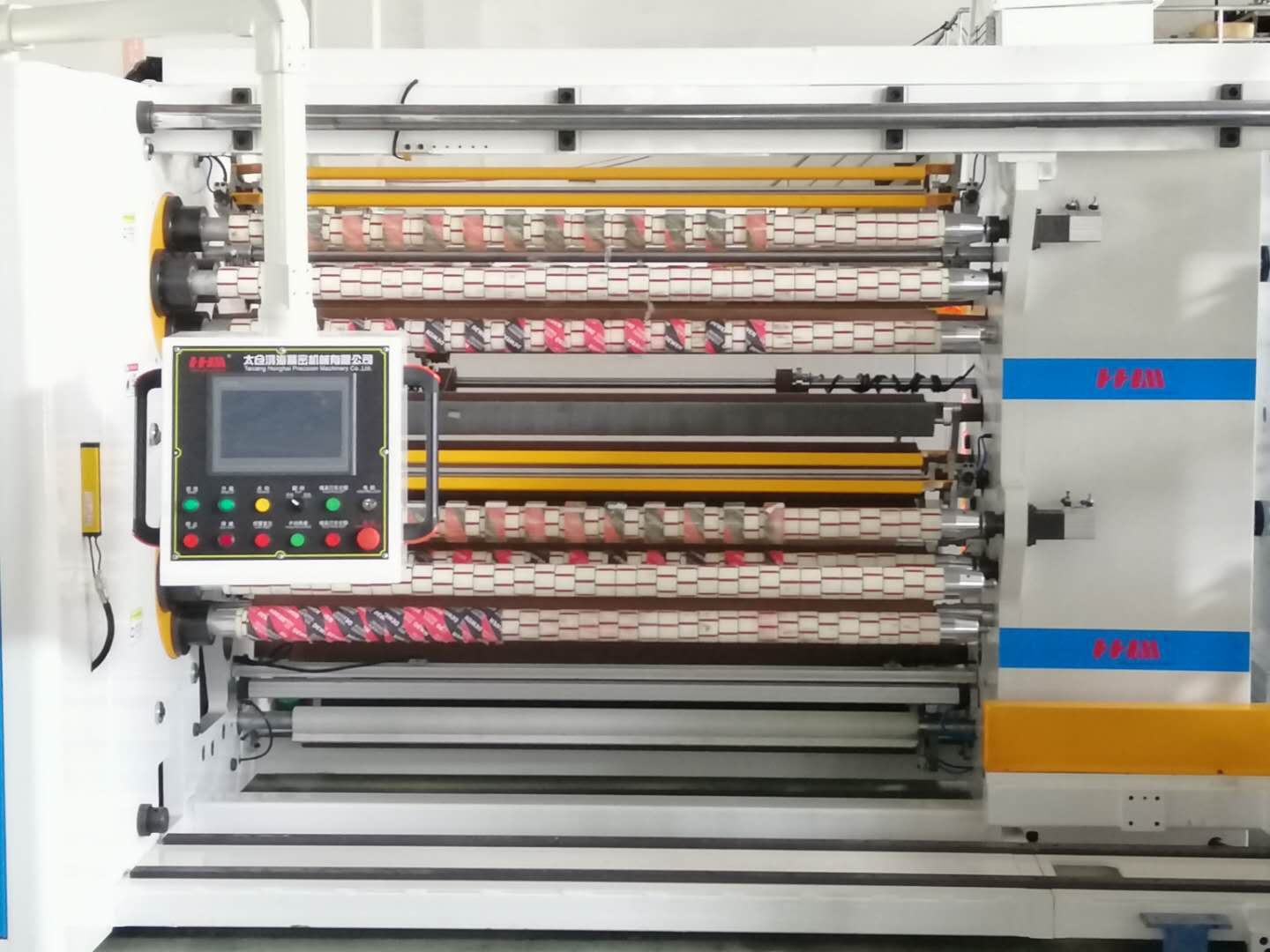
Before examining the internal mechanics of the equipment, we must understand the raw material itself. A standard BOPP jumbo roll consists of a microscopically thin polypropylene film substrate. This substrate is coated with an aggressive adhesive layer, typically a water-based acrylic, a solvent-based glue, or a synthetic hot-melt rubber.
The physical dimensions of these master rolls present formidable handling challenges. Standard jumbo rolls in the packaging sector measure between 1280mm and 1620mm in width. A single continuous roll can contain 4,000 to 6,000 meters of tape. Consequently, a fully wound jumbo roll often weighs upwards of 500 kilograms.
Handling such massive, sticky, and tension-sensitive material requires robust engineering. The primary hurdle lies in the initial unwinding phase. The adhesive layer creates substantial sticky resistance as the tape is forcefully pulled from the master roll. If the pulling force fluctuates even slightly, the inherently flexible BOPP film will stretch. Stretched film inevitably leads to deformed finished rolls and compromised adhesive bonding properties. Therefore, the processing machinery must exert continuous, calculated force to keep the web taut without ever exceeding the material's yield strength.
The conversion from a master roll to retail-ready products is a continuous, high-speed ballet of moving parts. The entire workflow breaks down into three fundamental stages. Each relies on synchronized mechanical and electronic systems.
The operation commences at the unwind station. Due to the extreme weight of the jumbo roll, operators load the material using heavy-duty hydraulic or pneumatic shaftless lifting mechanisms. This practical feature completely eliminates the need for dangerous manual lifting. Once firmly secured, the roll begins to feed the sticky tape web into the heart of the machine.
The most critical component here is the tension control system, typically governed by a Magnetic Powder Brake or a pneumatic braking system. As the jumbo roll gradually decreases in diameter, the physical force required to pull the tape changes dynamically. Advanced load cells continuously measure the web tension. They send real-time data to the central control unit, which automatically adjusts the braking torque. Furthermore, an Edge Position Control system physically shifts the entire unwind stand laterally. This micro-adjustment ensures the web enters the cutting section perfectly aligned.
Once stabilized and flattened, the web enters the slitting section. An industrial adhesive tape slitter utilizes highly calibrated blade configurations to divide the wide web into narrow strips. Walking past this section on the floor, you can often hear the distinct, high-pitched hum of blades slicing cleanly through the moving polypropylene.
For BOPP tape, razor blade slitting is the undisputed industry standard. The incredibly thin nature of BOPP film allows industrial razor blades to slice through cleanly without generating excessive dust. The web passes over a specifically grooved roller. Stationary razor blades are positioned at exact intervals to drop into the grooves, slicing the moving web in mid-air. Precision metal spacers dictate the exact distance between the blades, guaranteeing every single roll meets strict width tolerances.
After the web is sliced into dozens of strips, the tape must be wound onto individual, branded paper cores. High-efficiency production lines typically utilize a 4-shaft automatic turret exchange system. In this continuous configuration, two shafts actively rewind the cut tape at high speed. Simultaneously, the other two shafts remain idle. This allows operators or robotic automated systems to unload the finished rolls and stage fresh paper cores.
As the tape rapidly winds onto the cores, a crucial component known as the lay-on roller comes into play. It applies consistent, pneumatically controlled pressure against the growing surface of the tape roll. This deliberate pressure squeezes out any ambient air trapped between the thousands of layers. Eliminating these microscopic air bubbles gives high-quality BOPP tape its signature crystal-clear appearance.
Evaluating the technical specifications of a converting setup requires a deep look at its internal anatomy. High-performance models integrate several automated components designed to maximize throughput while engineering out human error. When upgrading a facility, sourcing a reliable tape slitting rewinding machine ensures these core components operate in perfect harmony. Top-tier machines often accommodate maximum unwinding widths of 1300mm to 1600mm and boast maximum rewinding diameters of up to 300mm.
Modern equipment relies heavily on Programmable Logic Controllers. Through an intuitive touch screen interface, operators input specific production parameters. These include target run length, maximum machine speed, and precise taper tension curves. The controller acts as the brain of the operation. It automates the delicate acceleration and deceleration phases, ensuring the machine ramps up to speeds of 180 to 200 meters per minute smoothly.
Manual loading of paper cores severely bottlenecks the production cycle. Advanced machines feature automatic core loaders that slide paper cores onto the rewind shafts exactly where needed. Coupled with a 4-shaft automatic exchange system, the machine rotates the shafts once the target length is reached. This drastic reduction in manual intervention allows for near-continuous operation.
The outermost edges of a jumbo roll are notoriously uneven. During the slitting process, the outermost blades trim a tiny margin from both sides of the web. An automatic edge waste rewinder continuously collects these thin, sticky trims. It winds them into dense, manageable spools, keeping the production area immaculate.
Even with premium raw materials, processing sticky films presents inherent daily challenges. Modern engineering has developed specific mechanical solutions to address these exact pain points.
Telescoping occurs when the layers of the rewound tape shift laterally, causing the finished roll to resemble a cone. This defect is almost exclusively caused by an incorrect taper tension profile. Modern machinery mitigates this using closed-loop tension control systems. Precision load cells constantly measure the web pull, feeding data back to the central controller to micro-adjust the servo motors.
During high-speed continuous slitting, the adhesive layer can easily transfer onto the razor blades. As sticky glue builds up, it degrades the cutting edge. Advanced equipment addresses this through optimized web paths and specialized blade holders. These holders can apply a microscopic, continuous layer of silicone lubricant to the razor blades, preventing adhesive accumulation.
Air entrapment happens when processing ultra-thin BOPP films at high speeds. Ambient air gets trapped between the layers, resulting in unsightly cloudy bubbles. To counter this, modern slitters deploy precision-machined bowing rollers just before the slitting section. These curved rollers gently stretch the web outward, ensuring it is perfectly flat.
Procuring industrial converting equipment is a major capital expenditure. For facility managers, selecting the correct machinery is a direct investment in factory throughput. Rather than looking at abstract concepts, you need actionable criteria to evaluate your next purchase.
To make an informed decision, refer to this core comparison of slitting machine configurations:
Feature and Specification | Entry-Level Slitters | High-Performance Automated Slitters |
|---|---|---|
Operating Speed | 100 to 150 meters per minute | 180 to 300 meters per minute |
Shaft Configuration | 2-Shaft Manual Exchange | 4-Shaft Automatic Turret Exchange |
Tension Control | Manual or Open-Loop | PLC-Driven Closed-Loop with Load Cells |
Noise Level and Stability | Standard Steel Frame | Heavy-Duty Cast Iron Frame |
Best Suited For | Low-volume regional distributors | High-capacity commercial manufacturing |
First, evaluate your production capacity needs. The operational speed directly dictates your maximum daily yield. Achieving high speeds without compromising roll quality requires advanced drive systems, such as highly responsive servo drives.
Next, carefully consider the shaft configuration. Standard two-shaft machines require the operator to completely halt production to remove finished rolls. In stark contrast, a four-shaft automatic turret design allows for continuous production.
Finally, inspect the frame rigidity. At operating speeds exceeding 180 meters per minute, mechanical vibration becomes the primary enemy of precision slitting. Premium machines utilize heavy-duty, solid cast-iron side frames. Cast iron possesses superior vibration-dampening properties.
Even the most robustly engineered adhesive tape slitter requires a strict preventative maintenance protocol. Neglecting routine upkeep rapidly accelerates the wear on expensive internal servo motors and bearings. As a floor engineer, I can tell you that preventive care is much cheaper than unexpected downtime.
The most critical daily task is rigorous adhesive management. Adhesive migration is unavoidable when processing BOPP tape. At the end of every production shift, operators must thoroughly clean the idler rollers, nip rollers, and lay-on rollers using an industrial solvent. Any residual glue left on the rollers will cause severe web tracking issues the next morning.
Weekly maintenance should focus on pneumatic and lubrication checks. Tape converting machines rely heavily on pneumatic systems to inflate the air shafts that grip the paper cores. Technicians must drain any accumulated condensation from the air compressor water traps. Furthermore, all linear guides and turret bearings must be lubricated with high-grade industrial grease.
Lastly, establish strict blade replacement protocols. Razor blades are highly consumable. Establish a replacement schedule based on the total linear meters cut, rather than waiting for visual defects. Operating with dull blades increases web tension and causes micro-tears in the film.
The journey from a colossal, heavy jumbo roll to a perfectly wound roll of packaging tape is a true marvel of modern industrial engineering. It requires a delicate, continuous balance of applied physics, precise tension control, and razor-sharp accuracy. Every single stage must execute flawlessly to maintain material integrity.
Ultimately, the quality, clarity, and performance of the finished tape are directly proportional to the machinery utilized on your factory floor. By understanding the intricate mechanics behind the process and investing in robust, automated equipment, you can effectively eliminate material waste and solve common production defects.
If you are looking to scale your output and meet surging global packaging demands, selecting the right equipment partner is crucial. We highly recommend evaluating your current setup and exploring the advanced, high-efficiency solutions available. You can find industry-leading products tailored to your exact specifications at HHM Machinery to drive your production forward.
Modern industrial converting machines typically operate at sustained speeds ranging from 150 to 300 meters per minute. The exact operational speed depends heavily on the drive system, the structural rigidity of the cast-iron frame, and the specific micron thickness of the BOPP film being processed.
Yes. While these specific machines are engineered to handle the unique tension requirements of BOPP, versatile models can often process masking tape, double-sided tissue tape, PVC electrical tape, and Kraft paper tape. However, switching materials usually requires recalibrating the tension profiles and swapping the cutting mechanisms.
Slitting refers strictly to the mechanical action of cutting a wide master web into multiple narrower strips using razor or shear blades. Rewinding is the subsequent process of spooling those newly cut strips onto individual, smaller paper cores. In modern manufacturing, a single integrated tape slitting rewinding machine performs both actions simultaneously.
The total yield depends entirely on the dimensions of the jumbo roll and the target width of the finished product. For instance, a standard jumbo roll measuring 1280mm in width, when slit into standard 48mm packaging tape, will yield exactly 26 finished rolls per cycle, with a very small margin allocated for automatic edge trimming waste.
Yes, a reliable industrial air compressor is an absolute necessity. Pneumatic power is required to inflate the friction air shafts that lock the paper cores in place, actuate the heavy lay-on rollers, control the braking mechanisms, and power the automated unloading systems. Supplying clean, dry air is critical for the machine longevity.
Telescoping is primarily caused by inconsistent web tension or poor alignment during the rewinding phase. If the tension is too loose, the layers slide over each other. If it is too tight, the core can crush or the inner layers squeeze outward. Upgrading to a machine with closed-loop tension control and an Edge Position Control system effectively eliminates this defect.
Blade lifespan varies based on the film thickness, machine speed, and adhesive aggressiveness. However, in a high-capacity continuous production environment, industrial razor blades are typically rotated or replaced every two to three shifts. Waiting until the blades are visibly dull will result in jagged tape edges and increased material waste.
