
Views: 0 Author: Site Editor Publish Time: 2026-10-24 Origin: Site
Few scenarios on the production floor are more frustrating for print shop managers than pulling a freshly processed roll off the pneumatic shaft, only to find the layers have slipped sideways. This progressive lateral shifting visually resembles a collapsed pirate telescope. It is a critical structural failure in web handling.
Telescoping is not just a cosmetic flaw. It completely compromises the physical structure of the roll. Delicate web edges become exposed to transit damage, inevitably driving up massive material waste. When these defective rolls reach the end-user, they cause severe jamming in automated label applicators. The direct result is rejected orders and delayed shipments.
Many converting operations accept this defect as a normal cost of doing business. It is entirely preventable. The root causes consistently trace back to improper tension management, physical substrate variations, or reliance on outdated mechanical equipment. By understanding the underlying physics of web handling and transitioning to modern converting technology, production facilities can permanently engineer this costly defect out of their workflow.
Telescoping is fundamentally a tension failure: Incorrect winding parameters represent the primary mechanical catalyst for lateral roll slippage. Rolls wound too tightly or too loosely will inevitably fail.
Modern materials demand dynamic handling: Microscopic caliper variations and adhesive cold flow in pressure-sensitive substrates require specialized tension isolation.
Alignment dictates stability: Uncalibrated or degraded web guiding sensors force the substrate to drift laterally during high-speed rewinding.
Equipment architecture impacts your bottom line: Upgrading from legacy solid-shaft setups to advanced differential friction systems is the most empirically proven method to eliminate telescoping permanently.
In the highly precise field of web handling, telescoping is the progressive lateral displacement of web layers. This shifting occurs during or immediately after the rewinding phase. Instead of forming a perfectly flush and cylindrical edge, the material layers slide outward or inward. The resulting roll assumes a convex or concave profile. Internal stresses overcome the static friction holding the individual layers together, forcing the material to move.
Operators often use the terms interchangeably, yet dishing and telescoping represent distinct structural failures. They require entirely different diagnostic approaches. Dishing appears as a uniform, bowl-like curve across the entire edge of the roll. This typically points to a constant web misalignment or a core that has shifted uniformly on the shaft. Telescoping involves the progressive, step-like sliding of individual layers against one another. This indicates a complete breakdown of internal roll friction.
The business impact of this breakdown hits hard. From a frontline operational standpoint, telescoped rolls cannot be salvaged easily. Converters face high rates of material scrap and elevated labor costs as operators attempt to rewind defective batches. Consequently, overall equipment effectiveness plummets.
The structural integrity of any rewound roll relies entirely on the precise management of radial and tangential stresses. A delicate balance of friction holds the web together. When a label slitter rewinder fails to maintain exact tension parameters, this friction collapses. The web layers simply seek the path of least resistance.
Winding a roll with insufficient tension introduces trapped air between the substrate layers. This air acts as a frictionless barrier. It prevents the inner layers from locking together. As the roll grows larger and heavier, the outer layers apply downward pressure. The loosely packed inner core shifts laterally under its own weight.
Applying excessive tension creates a dangerous buildup of internal radial pressure, commonly known as cinching. The outer layers squeeze the inner layers with immense force. The tightly packed inner layers have nowhere to compress vertically, so the material squeezes out of the side of the roll. The effect is much like toothpaste being forced from a tube.
Winding tension cannot remain static if you want to build a structurally sound profile. As the diameter of the roll increases, the torque required to maintain the same web tension also scales up. A machine applying constant tension from the core to the final layer will cause the outer layers to crush the interior.
Automated taper tension solves this issue. Taper tension is a programmed control profile that gradually decreases the winding force as the roll diameter expands. Legacy machinery relying on manual clutches cannot execute this curve accurately. Modern closed-loop systems continuously monitor the roll diameter. They adjust torque in milliseconds through precision load cells, ensuring the outer layers are wound softly enough to prevent lateral displacement.
Even perfectly calculated tension parameters cannot save a web that travels off-center. A web failing to travel in a perfectly straight geometric line will inevitably telescope. Lateral movement during the high-speed slitting process translates directly into roll instability.
Modern converting lines utilize Edge Position Control or Line Position Control systems to maintain strict web geometry. These systems employ ultrasonic or photoelectric sensors to monitor the edge of the substrate. If the web deviates, an automated actuator slightly pivots the guide frame to correct the path.
The production floor is a notoriously harsh environment. Sensor lenses easily become obscured by airborne paper dust or microscopic adhesive spray. Dirty or miscalibrated sensors cause electrical latency. The web begins to drift back and forth erratically. This continuous lateral swaying forces the material to wind unevenly, generating internal lateral stresses that trigger immediate telescoping.
NIP rollers isolate the unwind tension zone from the rewind tension zone to pull the material uniformly. Pneumatic cylinders control these rollers. If they apply uneven pressure, one side clamps down harder than the other. The web naturally pulls toward the high-pressure side. This diagonal pulling skews the material just milliseconds before it reaches the rewind shaft, virtually guaranteeing a telescoped edge.
Basic mechanical flaws are only part of the equation. The physical properties of the substrate itself frequently dictate winding stability. Not all materials behave predictably under tension.
Raw material webs are rarely perfectly uniform. A master roll might exhibit microscopic caliper variations, meaning it is slightly thicker on the left edge than on the right. A difference of a few microns seems negligible to the naked eye. Multiplying that variance by thousands of layers creates a massive defect known as a gauge band.
The thicker side of the web builds a larger diameter faster. A standard solid rewind shaft rotates at a single uniform speed. Therefore, the larger diameter side is subjected to exponentially higher web tension. The thinner side goes slack. This severe cross-web tension differential forces the looser layers to slide outward.
Current global packaging trends heavily compound these material challenges. The industry is aggressively shifting toward sustainable, down-gauged materials. Converters are frequently asked to process ultra-thin PET liners or recycled face stocks to meet eco-friendly quotas. These modern substrates lack the structural rigidity and tensile strength of traditional stocks. This industry-wide downgauging drastically shrinks the operational window for tension control.
When operating a self-adhesive label paper slitter, engineers must also manage the rheology of the adhesive layer. Slitting blades generating excessive heat or overly aggressive winding tension will cause pressure-sensitive adhesives to cold flow. The adhesive oozes out from the slit edges. It acts as a liquid lubricant between the layers. This drastically reduces the static friction required to hold the roll together, facilitating immediate lateral slippage.
The physical degradation of converting equipment naturally disrupts the delicate balance of forces required for flush roll profiles.
Operators commonly hold the misconception that high processing speeds directly cause telescoping. Empirical production data proves otherwise. Steady, high-speed winding is perfectly stable. The true catalyst for layer slippage is erratic kinetic energy.
Rapid acceleration or aggressive emergency deceleration creates violent spikes and drops in web tension. These sudden kinetic shocks shatter the static friction between the wound layers. Smooth, programmed acceleration ramps are non-negotiable for maintaining stability. Precision servo motors and variable frequency drives control these ramps effectively.
The cardboard or plastic core forms the structural foundation of any rewound roll. Pneumatic air shafts utilize expanding bladders to push friction lugs against the inside of the core, locking it in place. Over years of heavy use, these bladders develop micro-leaks. The external lugs wear down and lose their grip. The core will micro-slip against the steel shaft while the machine is pulling the web. Tension drops to zero instantly, ruining the entire structural integrity of the roll.
Addressing telescoping requires a systematic, diagnostic approach. Guesswork leads to wasted material. Facility managers should implement standardized protocols to stabilize output immediately.
Tension Calibration: Adjust the initial winding tension and taper tension percentage based on the specific substrate recipe. Extensible films require vastly different taper curves than rigid paper stocks to balance radial stress.
Sensor Maintenance: Mandate that operators clean ultrasonic and photoelectric web guide sensors with approved isopropyl alcohol solutions at the start of every shift. This eliminates sensor-induced web drift.
Core Inspection: Verify that cardboard cores are stored in a climate-controlled environment. Cores absorbing ambient humidity will swell, preventing a secure fit on the pneumatic rewind shafts.
Hardware Audits: Routinely measure NIP roller durometer for uneven wear. Inspect air shaft lugs for adequate pneumatic expansion to eliminate mechanical variables.
Strict operational protocols mitigate telescoping to a degree. Facilities processing varying calipers or highly complex self-adhesive materials often find that standard solid-shaft rewinders are mathematically insufficient. The most definitive engineering solution is upgrading the fundamental equipment architecture.
Standard air shafts lock all cores simultaneously. If one roll builds a larger diameter due to material thickness variations, it dictates the tension for the entire shaft. Adjacent thinner rolls will inevitably telescope.
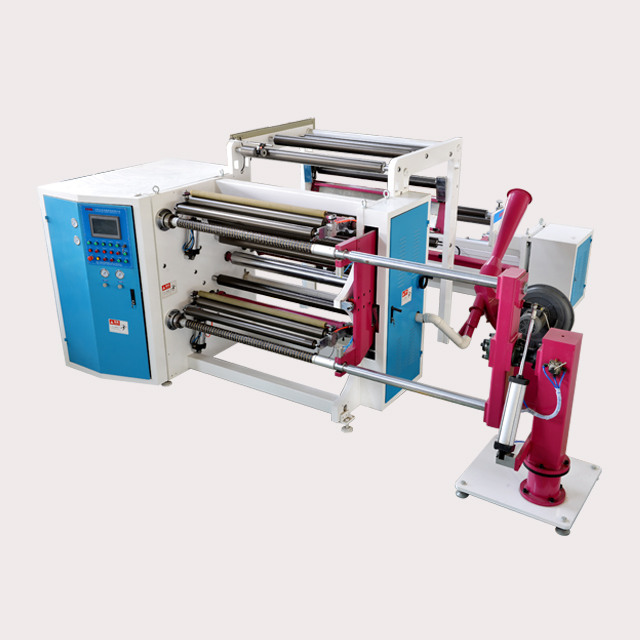
A modern double-shaft slitting machine eliminates this mechanical flaw by utilizing differential friction shafts, commonly known as slip shafts. Instead of a single expanding bladder, these advanced shafts feature multiple independent friction rings. Through precise pneumatic control, the machine drives the central shaft slightly faster than the web speed. This allows individual rings to slip at different, highly controlled rates.
The differential rings slip independently. Each individual slit roll maintains its own optimal tension profile. It remains entirely unaffected by the caliper variations of adjacent rolls. This independent tension isolation ensures no single roll becomes too tight or too loose. Advanced models can achieve stable running speeds up to 600m/min while slitting multiple narrow lanes of highly sensitive, down-gauged film. Differential shafts effectively engineer telescoping out of the production equation.
Selecting the correct machinery is a critical capital expenditure for converting operations looking to stabilize output and protect profit margins. Production engineers must evaluate equipment based on its ability to handle modern, complex substrates. Below is a frontline comparison of legacy versus modern slitting architectures.
Feature | Legacy Solid Air Shafts | Advanced Differential Slip Shafts |
|---|---|---|
Tension Control | Uniform across the entire shaft. | Independent tension for each individual roll. |
Material Suitability | Thick, uniform paper stocks. | Ultra-thin films, uneven caliper substrates, self-adhesives. |
Telescoping Risk | High, especially with gauge bands. | Virtually eliminated through slip compensation. |
Operational Speed | Requires slowing down for sensitive materials. | Maintains stability at high speeds up to 600m/min. |
When evaluating a new system, demand closed-loop tension control systems that utilize high-precision load cells. These provide real-time feedback to the PLC. The Human-Machine Interface must allow operators to input and save specific taper tension curves for different material recipes. Integrating dual differential slip shafts is absolutely non-negotiable for guaranteeing flush, telescope-free roll profiles.
Telescoping remains one of the most expensive defects in the web handling industry. It is a direct symptom of poor tension management, uncompensated material thickness variations, and degraded machinery. Implementing strict operational maintenance and calibrating your taper tension profiles will drastically reduce roll slippage.
The ultimate solution lies in modernizing your production floor. Stop fighting with outdated equipment that damages your materials and delays your shipments. Upgrading to advanced, differential-shaft slitting technology is the most reliable way to ensure perfectly flush, high-quality rolls. To permanently eliminate telescoping and elevate your production efficiency, explore the high-performance slitting solutions available at https://hhmmach.com.
Speed itself does not inherently cause telescoping. Inconsistent kinetic energy is the real culprit. Rapid starts, sudden emergency stops, and aggressive acceleration cause massive tension spikes and drops across the web. These severe fluctuations disrupt the programmed taper tension profile, leading to immediate roll slippage. A modern, servo-driven machine handles high speeds smoothly through programmed acceleration ramps, keeping the tension stable and the roll perfectly flat.
Telescoping refers strictly to the lateral sliding of the entire rewound roll, resulting in a misaligned, cone-like physical structure. Wrinkling or curling happens to the actual web material itself. Curling is typically caused by trapped air bubbles, moisture absorption issues in the paper liner, or excessive web tension that physically stretches the film memory before it is even rewound onto the core.
Machines specifically designed for pressure-sensitive materials utilize non-stick coated rollers and highly precise thermal and tension controls. By ensuring the web does not overheat at the rotary slitting blades, and by preventing the rewind tension from squeezing the layers too tightly, the machine prevents the adhesive from cold-flowing out of the slit edges. This keeps the internal static friction between layers stable, preventing the roll from sliding laterally.
Yes, it is the most effective mechanical solution for this specific problem. By utilizing differential friction rings, the machine allows thicker rolls to slip slightly on the central shaft. This mechanical compensation ensures that every single individual roll receives the exact right amount of tension. It prevents telescoping across the entire web regardless of microscopic caliper variations in the master roll.
Attempting to salvage a telescoped roll is generally not cost-effective and often damages the material further. Rewinding a telescoped roll requires passing it through the slitter again at very low speeds with modified tension settings. Even then, the edges of the web have likely suffered micro-tears or adhesive bleed during the initial slippage. The best practice is prevention at the primary slitting stage.
Thin extensible films, such as 20-micron PET or PE, require a highly aggressive taper tension profile compared to rigid paper. Engineers typically program a taper drop of 25 to 40 percent from the core to the final outside diameter. This significant reduction in torque prevents the outer layers from stretching the film memory and crushing the inner core, which would otherwise force the layers to telescope outward.
