
Views: 0 Author: Site Editor Publish Time: 2026-10-31 Origin: Site
Are your slit rolls winding too tight or sagging? Material thickness variations cause massive waste during multi-width runs. A differential shaft slitting machine fixes this specific tension issue. It automatically compensates for microscopic discrepancies across the web. In this technical guide, we break down exactly how these advanced systems work. You will learn when your production line absolutely needs one and how to optimize the equipment for maximum yield.
Picture a busy factory floor. Operators scramble to adjust a web that is stretching on one side and drooping on the other. They frantically try to prevent a roll from telescoping. Modern tension control systems are engineered to eliminate this exact chaos. They turn unpredictable converting jobs into a highly profitable, streamlined process.
Differential shafts allow individual slit rolls to slip at different speeds on the same rewind shaft. This maintains uniform tension across the entire web.
These components are strictly essential for multi-width runs. Winding different widths simultaneously heavily exacerbates inherent material thickness variations.
Upgrading to a sophisticated tension-control system drastically reduces scrap rates. It prevents roll telescoping and optimizes overall production yield for delicate materials.
Understanding the mechanical causes of irregular shaft slipping helps maintenance teams troubleshoot effectively. This is critical to maintaining high operational uptime.
Choosing between a standard air shaft and a friction-based system depends entirely on your material type, production volume, and specific tolerance requirements.
As engineers, we classify a differential shaft slitting machine as a highly specialized piece of converting equipment. Its primary function is to cut large master rolls of web material into narrower coils. Standard slitters rely on solid rewind shafts. In contrast, this advanced machinery features segmented shafts composed of multiple independent friction rings. These mechanical rings allow each individual rewinding roll to rotate independently at its own required speed. By doing so, the machine compensates for minute differences in roll diameter. It ensures uniform tension across all finished rolls, regardless of their position on the web.
In the converting industry, the terms differential shaft and friction shaft are frequently used interchangeably. From an engineering standpoint, they refer to the exact same tension-control mechanism. A friction shaft slitting machine utilizes internal pneumatic bladders. These bladders expand to push friction pads against outer rings. The rings then grip the cardboard or plastic core of the material. As the machine runs, the rings slip internally against the base shaft at varying rates. This compensates for speed differences caused by uneven roll diameters. This precisely controlled friction is what creates the differential speed.
Running a multi-width slitting machine introduces complex mechanical variables. These variables simply do not exist when processing a single width. Cutting one master coil into several smaller rolls of varying widths creates a mechanical problem. The tension dynamics become highly unstable. The primary culprit behind this instability is the physical reality of the raw material itself.
We are currently witnessing a massive industry shift toward ultra-thin substrates. Sustainability mandates in flexible packaging and the booming demand for high-density electric vehicle batteries drive this change. Manufacturers frequently push films and metallic foils down to 9 microns or less. At these microscopic thicknesses, the margin for tension error approaches zero. Conventional solid shafts are rapidly becoming obsolete in these high-stakes environments. Advanced tension compensation is now a strict requirement rather than an optional upgrade.
Empirical data shows that no web material is perfectly flat. Whether it is plastic film, aluminum foil, or coated paper, a master roll always contains microscopic gauge variations. It is slightly thicker in some areas and thinner in others across its web width. When winding these materials, thicker sections build up roll diameter much faster than thinner sections. According to the physics of web handling, larger diameters require a slower rotational speed to maintain the same linear web tension. If the rotational speed remains constant, the larger diameter rolls pull the material faster. This increases the tension exponentially.
When using a standard solid air shaft for multi-width runs, all cores lock onto the shaft. They are forced to rotate at the exact same speed. Because of the thickness variations mentioned above, the thicker rolls end up absorbing all the web tension. This causes them to wind too hard. The material stretches, printed graphics distort, and cores can get completely crushed. Conversely, the thinner rolls lose their necessary tension. Without adequate pulling force, these rolls become loose and sag during the run. Ultimately, they suffer from telescoping, where the layers slide laterally off the core. This dynamic results in high scrap rates and severely impacts production profitability.
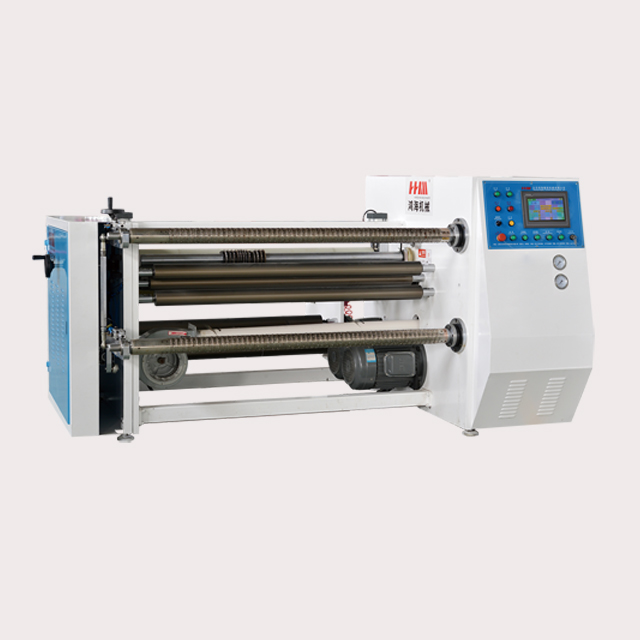
To solve the gauge variation problem, converting engineers developed the differential shaft slitter rewinder. This equipment relies on a sophisticated mechanical and pneumatic system. It successfully decouples the rotational speed of the shaft from the rotational speed of the individual rolls.
The core of this technology is the differential shaft itself. It consists of a central steel base shaft containing internal air bladders. Multiple segmented outer friction rings surround this base shaft. When an operator slides a core onto the shaft, the friction rings expand outward to securely grip the inside of the core. However, the rings themselves are not permanently locked to the central shaft. Instead, they sit on friction pads. These pads interface directly with the internal air bladders and are often made of specialized heat-resistant felt or engineered polymers.
The machine supplies a constant, precisely regulated air pressure to the internal bladders of the shaft. This pressure dictates the amount of friction applied against the rings. When a specific roll builds a larger diameter due to material thickness, it naturally experiences higher tension. Once this tension exceeds the friction threshold set by the air pressure, the friction ring slips slightly on the base shaft. This slipping action slows the roll rotation just enough to bleed off the excess tension. It keeps the tension identical to the smaller diameter rolls on the same shaft. Operators walking past the machine might even hear the subtle hiss of proportional valves adjusting the pressure in real-time.
Modern equipment does not rely on manual pressure adjustments. These machines utilize closed-loop tension control systems integrated with load cells or dancer rollers. As the overall diameter of the rewinding rolls grows, the system programmable logic controller automatically calculates the required torque. It incrementally increases the air pressure supplied to the differential shaft. This ensures that the friction slip rate remains perfectly calibrated from the core all the way to the finished outer diameter.
Selecting the correct shaft technology is a critical capital expenditure decision. You need a clear comparison of operational parameters to determine which system perfectly aligns with your production requirements.
Standard solid air shafts remain highly effective under specific conditions. They are best suited for single-width slitting operations where tension disparities are naturally minimal. They are also appropriate for processing thick materials with highly uniform profiles, or for low-end paper slitting where extreme tension control is not a critical quality parameter. If your scrap rate is naturally low and your material is forgiving, a standard shaft provides adequate performance with significantly lower maintenance costs.
Upgrading to a differential shaft becomes mandatory when processing high-value, thin-gauge materials. Substrates like PET, BOPP, lithium-ion battery foils, and flexible packaging laminates are highly sensitive to tension spikes. Specifically, if you operate a multi-width line, differential shafts are absolutely non-negotiable to prevent telescoping and material stretching.
Evaluation Metric | Standard Solid Air Shaft | Differential Shaft System |
|---|---|---|
Material Suitability | Thick paper, non-wovens, uniform boards | Thin films, foils, flexible packaging, laminates |
Width Configuration | Single-width runs | Multi-width simultaneous runs |
Tension Tolerance | Low to Moderate | Extremely High with precise roll control |
Expected Scrap Rate | High during varying thickness runs | Very Low due to optimized yield |
Initial Investment | Lower | Higher but offers rapid ROI through waste reduction |
Deploying a differential shaft system is only the first step. Optimizing its daily operation is necessary to achieve maximum yield and equipment ROI. Plant managers must implement standardized strategies on the factory floor to continuously enhance efficiency.
The physical arrangement of different slit widths on the rewind shafts significantly impacts overall machine performance. To balance the mechanical load and minimize scrap, engineers strongly recommend alternating wide and narrow cuts across the web whenever possible. Grouping all wide cuts on one side and narrow cuts on the other causes uneven pressure distribution on the nip rollers and web guides. Furthermore, optimizing the slit pattern through nesting algorithms ensures that the maximum usable width of the master coil is utilized.
Machine downtime during changeovers is a major source of lost revenue. Modern pneumatic friction shafts allow for rapid core positioning. Unlike older mechanical shafts that required operators to manually insert physical spacers between every single roll, advanced differential rings grip the cores wherever they are placed. Operators can utilize laser core alignment systems to slide the cores into exact positions in seconds. This drastically reduces setup times and improves overall machine efficiency.
Even the most advanced equipment requires proactive maintenance. When operators experience tension inconsistencies on the factory floor, systematic troubleshooting is required to identify and resolve the root causes of shaft slipping errors.
If a roll is slipping too much or irregularly, the most common empirical cause is worn-out friction rings or degraded internal felt pads. Insufficient air pressure from the pneumatic system can also prevent the bladders from applying uniform pressure. An accumulation of paper dust and plastic debris inside the shaft mechanism is another frequent culprit.
Implement a strict regular cleaning protocol using compressed air to remove debris from the shaft segments. Maintenance teams must routinely check pneumatic lines for micro-leaks and verify the output of the proportional air valves. Worn friction pads and rings must be replaced according to the manufacturer lifecycle specifications to restore proper torque transfer.
When finished rolls exhibit uneven edges or slight width variations, the differential shaft is rarely the primary failure point. This issue is typically caused by improper web guiding before the material reaches the slitting section. Uneven unwind tension causing the material to shift laterally as it enters the knives is also a common factor.
Calibrate the automated web guiding system and verify that the unwind brake is functioning correctly. In addition, ensure that the friction rings are properly sized for the cores being used. If the inner diameter of the cardboard or plastic core is slightly too large, the rings will not grip securely. This causes lateral wandering during the slipping phase.
Sourcing industrial slitting equipment requires a rigorous evaluation of mechanical capabilities, automation levels, and integration potential. For plant managers, selecting the right machine involves analyzing several critical engineering parameters. Let us look at the exact specifications you should demand for a high return on investment.
Throughput is a primary metric for any converting operation. Modern high-speed slitting lines must operate efficiently at high speeds. For instance, advanced double shaft models easily achieve speeds of 400 to 500 meters per minute. High-speed rewinding generates significant thermal energy inside the differential shafts due to continuous slipping. Look for systems that utilize specialized heat-resistant felt pads or advanced pneumatic cooling structures. Automation features such as automatic knife positioning and laser-guided core alignment drastically reduce setup times between jobs.
Differential shafts are generally categorized into two main actuation types. Mechanical differential shafts rely on mechanical side-pressure to compress the friction rings together. While cost-effective, they offer less precise tension control. Pneumatic differential shafts utilize central air bladders that expand to push friction strips outward. The machine proportional valve controls the air pressure dynamically as the roll diameter increases. This closed-loop system provides highly accurate, independent tension control. It is the industry standard for any high-performance multi-width run.
The architectural layout of the machine dictates its footprint and material handling capabilities. For operations prioritizing precise tension management over massive roll diameters, a center slitting rewinding machine ensures that the rewinding shafts are driven directly from the center. This provides excellent control for delicate films and foils. Equipment featuring dual 3-inch slip shafts and industrial-grade servo motors offers the highest reliability. Both configurations require sophisticated closed-loop tension controllers to feed real-time diameter data back to the pneumatic friction shafts.
Upgrading to modern slitting equipment requires careful financial planning, but the long-term benefits are undeniable. A differential shaft slitter rewinder reduces material waste instantly by ensuring that independent tension control stops rolls from telescoping or sagging. This mechanical precision turns complex multi-width slitting into highly profitable work. By evaluating your specific material profiles and production needs, your facility can achieve significantly higher yields with far fewer rejected rolls.
If your production line struggles with tension inconsistencies, it is time to upgrade your converting capabilities. Evaluate your specific material profiles and production volume needs. Visit HHM Machinery to explore high-configuration center friction shaft slitting machines and double shaft high-speed models. Equip your facility with the exact technology required to achieve higher yields and eliminate rejected rolls today.
In many industrial scenarios, yes. If your current equipment possesses compatible servo drive systems and programmable tension controllers, you can physically replace a solid air shaft with a differential shaft. The mechanical swap is only part of the process. You will also need to upgrade the pneumatic control system. Differential shafts require precise, dynamic air pressure regulation via proportional valves to adjust the friction as the roll diameter grows. If your legacy controller cannot output these dynamic tension curves, a full control system retrofit will be necessary.
Highly sensitive materials that exhibit varying thickness profiles derive the most benefit from this technology. This primarily includes thin plastic films such as BOPP, PET, and PVC. Metallic substrates like aluminum foil and copper foil used in electronics require absolute tension precision to prevent stretching or micro-cracking. Laminated flexible packaging materials also necessitate this machinery to manage the uneven build-up of material on the rewind core.
Telescoping is a direct result of tension loss during the rewinding phase. On a standard solid air shaft, all rewinding cores are locked into a single rotational speed. Because master webs have microscopic thickness variations, the thicker sections of the web build a larger roll diameter faster than the thinner sections. The larger diameter rolls end up absorbing all the pulling force from the machine. This leaves the smaller diameter rolls with insufficient tension to lock the layers together, causing them to slide laterally.
No, differential shafts are engineered to accommodate standard industry cores. This includes both cardboard and plastic variants. Precise dimensioning is critical. The friction rings on the shaft must be sized accurately to match the inner diameter of your specific cores. If the core inner diameter is outside acceptable tolerances, the friction rings may slip against the inside of the core rather than slipping internally against the base shaft. This improper slipping generates excessive dust and damages the core interior.
The lifespan of friction components depends entirely on your production speed, material tension requirements, and operating environment. In high-speed operations running multiple shifts, felt pads may require replacement every six to twelve months. Keeping the shaft internals free of paper dust and plastic debris significantly extends the operational life of these consumable parts.
Yes, continuous slipping generates thermal energy. If the heat exceeds the design limits of the friction pads, the coefficient of friction can change. This leads to unstable tension control. High-quality shafts utilize engineered heat-resistant materials and internal pneumatic cooling structures to dissipate this heat. This ensures consistent torque transfer even during long, high-speed multi-width runs.
