
Views: 0 Author: Site Editor Publish Time: 2026-10-18 Origin: Site
Are deformed edges ruining your PET film rolls? For many converters, material waste is not just an occasional nuisance. It is a daily hemorrhage of profits that costs factories thousands. Polyethylene Terephthalate, known universally as PET film, is highly prized for its tensile strength and clarity. Yet, it remains notoriously tricky to process on the factory floor. Because the substrate is hyper-sensitive to tension and heat, even minor operational miscalculations can instantly ruin a master roll. You are often left staring at flanging, burrs, or severely stretched edges.
Achieving perfectly consistent rolls requires more than operator intuition. It demands a precise combination of correct operational techniques, optimal blade setups, and investing in the right machinery. In this guide, we will uncover the root causes of edge deformation. We will also provide actionable solutions from a field engineering perspective, exploring why upgrading your equipment might be the ultimate fix for your production bottlenecks.
Before diving into the mechanics, we must acknowledge a massive shift in the flexible packaging market. Global sustainability targets are driving a rapid trend toward heavily downgauged films. Converters are now routinely tasked with slitting PET films as thin as 10 to 12 microns. While thinner materials reduce plastic usage, their tolerance for tension fluctuations and blade friction drops exponentially. Older machines relying on open-loop control systems simply cannot react fast enough to these micro-variations. This industry-wide downgauging is exactly why legacy equipment is suddenly producing unprecedented scrap rates, forcing smart manufacturers to rethink their winding technologies.
Edge deformation is primarily triggered by dull blades, improper tension control, and excessive heat buildup during the run.
Shear slitting stands out as the most effective cutting method, consistently providing cleaner edges compared to traditional razor cutting.
Precise tension control utilizing taper tension profiles is strictly non-negotiable for preventing telescoping and stretched edges.
Upgrading to a center surface configuration aggressively eliminates trapped air to ensure perfectly straight roll profiles.
Investing in modern machinery drastically reduces material waste and significantly boosts long-term return on investment.
To achieve a flawless roll profile, you first need to respect the physical properties of PET. Its high tensile strength and dimensional stability make it a premium packaging material. However, these exact properties make it incredibly unforgiving to slit. When edges fail, it is rarely a single catastrophic event. Instead, it is a cascading failure of mechanical misalignments.
Tension serves as the invisible backbone of any web handling process. Picture a master roll spinning at 500 meters per minute. If the film tension profile does not adapt dynamically, disaster is imminent. Excessive tension physically stretches the film beyond its elastic limit. When this over-stressed film is finally wound onto the rewind core, it attempts to snap back to its original state. This microscopic retraction causes the edges to thicken and raise. We call this frustrating defect flanging or curling. Conversely, insufficient tension means the film layers fail to grip each other tightly. This lack of friction leads to telescoping, where the roll slides outward like an extended spyglass.
Slicing through PET requires surgical precision. When blades lose their edge, you can often hear a distinct, high-pitched whine echoing across the production floor. The blades no longer slice cleanly through the polymer chain. Instead, they punch or tear through the material. This aggressive tearing creates micro-fractures along the film edge, leading to burrs and heavy dust generation. Furthermore, if the shear blades have an incorrect overlap or cant angle, they force the film sideways before cutting it. The result is a fractured, uneven edge profile.
Despite its overall stability, PET is highly sensitive to localized thermal spikes. During high-speed operations, relentless friction between the film and cutting blades generates significant thermal energy. If the blades lack proper heat dissipation, or if the line speed exceeds the mechanical limits of the cutting setup, the microscopic edge of the film actually melts. Once the film cools on the rewind roll, this warped edge solidifies into a permanent deformation.
Before the film even reaches the slitting knives, it must be perfectly aligned. Subpar web guiding systems allow for lateral movement, often referred to as web wandering. If the film shifts laterally by even a fraction of a millimeter as it passes through the blades, the resulting cut becomes wavy. This uneven width creates distinct high and low spots on the final roll, severely compromising roll consistency.
Many facilities attempt to process high-strength materials on outdated machines. Squeezing a few more years out of legacy equipment might seem cost-effective initially. However, empirical data from the field reveals a different reality. Outdated machinery is frequently the root cause of high scrap rates and inconsistent quality.
The hidden costs of running outdated machinery are staggering. Frequent machine downtime occurs as operators halt production to recalibrate tension and splice broken webs. Relying on operator intuition rather than digital precision leads to severe inconsistencies across different shifts. To mitigate these costly errors, manufacturers must critically evaluate their current lines. Upgrading to modern, specialized film roll slitting equipment designed specifically for flexible packaging is often the most effective step toward eliminating waste.
Selecting the correct cutting method dictates whether the edge will be clean and flush, or jagged and deformed.
Converters generally rely on two common ways to slit flexible packaging films: razor slitting and shear slitting. Razor slitting involves pulling the film past a stationary blade. While economical for very soft films, it is profoundly problematic for PET. Dragging high-tensile PET against a stationary razor creates massive friction. This inevitably leads to rapid blade wear, deflection, and localized melting.
In contrast, shear slitting is the undisputed standard for PET. This method utilizes a top circular male blade and a bottom circular female anvil, operating like rotary scissors. Because the blades actively rotate and shear the material at a specific intersection point, drag is virtually eliminated.
Feature | Shear Slitting | Razor Slitting |
|---|---|---|
Best Suited For | High-tensile, tough materials like PET | Soft, extremely thin, non-abrasive films |
Edge Quality | Clean, flush, dust-free | Prone to melting, micro-tears, and burrs |
Friction Level | Very Low active rotation | Extremely High stationary drag |
Blade Lifespan | Long excellent ROI | Short requires frequent changes |
Implementing shear slitting is only half the solution. Precise setup is required. The bottom anvil must rotate slightly faster than the web speed, typically a 3 to 5 percent overspeed ratio. This ensures the film is pulled cleanly through the cut point without bunching. Additionally, the top blade must be set at a slight cant angle relative to the bottom blade. This specific geometry ensures only the very edge of the blades touch, concentrating the cutting force.
Tension control is never a static setting. It is a highly dynamic process that must constantly adapt as roll geometry changes.
The journey from the master roll to the finished slit rolls involves distinctly different tension requirements. A high-quality PET film slitting rewinding machine must successfully isolate the unwind tension from the rewind tension. At the unwind station, tension keeps the master roll taut. However, as the film passes through the nip rollers, the tension profile changes completely. The rewind section must apply a highly controlled, usually lower tension. This ensures slit ribbons are wound tightly enough to form stable rolls, but loosely enough to prevent inner layer collapse.
The most critical aspect of winding PET film is implementing taper tension. As a rewind roll grows in diameter, the outer layers exert massive compressive force on the inner layers. If the rewind tension remains constant, the cumulative pressure will mercilessly crush the core. This forces the inner layers to squeeze outward, resulting in severe edge deformation known as starring or dishing.
Taper tension resolves this by gradually decreasing the rewind tension as the roll diameter increases. Modern PLCs calculate the roll diameter in real-time, automatically tapering the tension according to a pre-set curve.
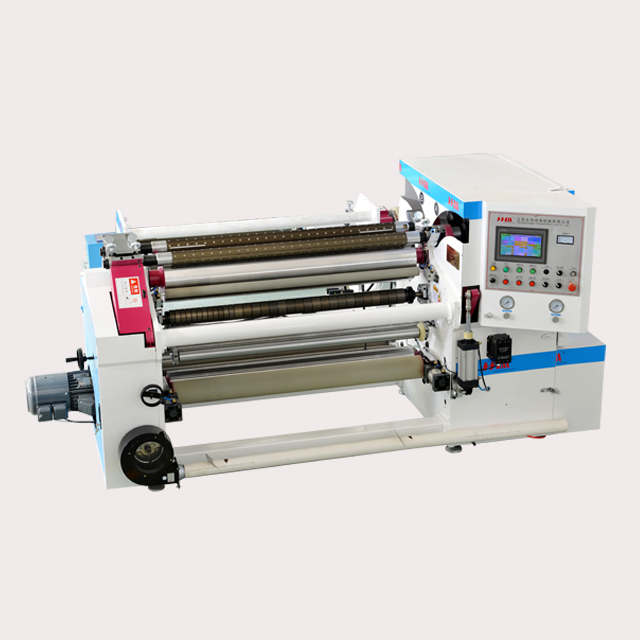
When processing high-tensile, slippery materials like PET, standard winding technologies often fall short. Generic center winders rely entirely on the rewind shaft to generate tension. This can lead to severe structural issues within the finished roll. To achieve flawless edge profiles, upgrading to a specialized center surface slitter is widely considered the industry standard.
Center surface winding brilliantly combines the torque-driven tension of a center winder with the nip-pressure control of a surface winder. Taking advanced equipment like the HH1300E model as an engineering benchmark, this configuration introduces a driven surface drum that maintains physical contact with the outside of the rewinding roll. The center shaft provides the primary winding torque. Meanwhile, the surface roller dictates the exact speed and applies precise, adjustable nip pressure. Working at maximum mechanical speeds up to 600 meters per minute, this dual-action mechanism allows operators to decouple web tension from winding tension. It provides absolute mechanical isolation, preventing the film from stretching at the edges even at a high working speed of 500 meters per minute.
One of the most persistent challenges when slitting PET film is air entrapment. Because PET film has an exceptionally smooth surface, high-speed winding naturally pulls ambient air into the roll. This trapped air acts as a microscopic layer of lubricant. When layers lose friction, the roll loses structural integrity, leading directly to telescoping.
The surface lay-on roller in a center surface system acts as a continuous squeegee. By applying calculated pneumatic pressure directly to the tangent point, it forces out boundary layer air before it gets trapped. The result is a highly dense, structurally sound roll with perfectly flush edges, easily accommodating rewind diameters up to 800mm without structural failure.
Even with premium equipment, operational best practices are required to maintain peak roll consistency. Implementing standardized procedures ensures the machinery performs exactly as designed.
Mechanical degradation happens gradually. Maintenance teams must routinely calibrate load cells to ensure accurate tension feedback. Nip rollers must also be checked for parallel alignment. A misaligned lay-on roller applies asymmetric pressure, causing one side of the PET film to stretch more than the other.
PET is an excellent electrical insulator, making it highly susceptible to static electricity. High static charges cause the film to stick to machine components or attract airborne dust. Facilities must utilize active static eliminators on the machine and maintain ambient factory humidity between 45 and 55 percent.
Faster is not always better. While modern machines are capable of blistering speeds, operators must find the optimal range for specific thicknesses. Pushing the speed beyond the material threshold exponentially increases boundary layer air entrapment and amplifies heat generation at the shear blades.
Dust generated from the slitting process can easily become trapped inside the rewind roll. Over thousands of layers, microscopic dust particles create localized high spots that distort the roll profile. Utilizing contact or non-contact web cleaning systems ensures only pristine film is wound onto the cores.
Sophisticated machinery cannot compensate for inconsistent human input. Different operators have different preferences for tension settings. Facilities must establish strict, documented recipes for different PET film grades to eliminate shift-to-shift variations.
Transitioning from a reactive production environment to a proactive one requires strategic capital investment. Evaluating machinery through the lens of long-term consistency is crucial.
When assessing new equipment, prioritize technological capabilities that remove human error. Based on top-tier engineering standards, your technical checklist should include:
Closed-loop tension control: Must feature high-precision load cells to adjust motor torque in milliseconds.
Robust Capacity Limits: Look for heavy-duty handling, such as a 1000mm maximum unwind diameter and an 800mm maximum rewind diameter, to process large master rolls efficiently.
Advanced web guiding: Ultrasonic or photoelectric sensors are vital to keep the web perfectly aligned before it hits the knives.
Automated blade positioning: Eliminates the inaccuracies and safety hazards of manual blade setup.
The initial capital expenditure of premium machinery is rapidly offset by profound operational savings. Investing in reliable equipment drastically reduces the volume of scrap material generated by flanging and wavy edges. Furthermore, automated systems reduce machine setup times significantly. Delivering perfectly consistent rolls allows manufacturers to avoid customer rejections and command premium pricing.
Deformed PET film edges are a completely solvable problem. Overcoming this challenge requires a deep understanding of material properties, selecting the superior shear cutting method, and mastering dynamic tension control. However, human operator skill and careful setup can only take you so far.
The true foundation of flawless roll consistency is the machinery itself. If your facility is struggling with high scrap rates and inconsistent outputs, it is time to evaluate your legacy equipment. Upgrade your production line to eliminate these costly bottlenecks. Explore high-performance solutions and find the perfect technological fit for your manufacturing needs at HHM Machinery to safeguard your profits and product quality.
Flanging is a specific type of roll deformation where the edges of the slit roll become noticeably thicker or flared out compared to the center. This defect is primarily caused by dull slitting blades stretching the material at the cut point, or by improper taper tension settings applying excessive stress to the outer layers.
Blade life depends entirely on production volume, operating speed, and film thickness. However, standard industry practice dictates visually inspecting blades at the start of every shift. Operators should look for micro-burrs or excessive dust generation. As soon as cut quality degrades, shear blades must be sharpened or replaced.
While razor slitting can technically be used for extremely thin, non-metallized films, it is highly discouraged for standard PET processing. PET possesses a high tensile strength that quickly wears down stationary razor blades, leading to heat buildup and melted edges. Shear slitting provides a much cleaner, more stable cut.
A standard center slitter generates winding tension exclusively through the motorized center shaft. This often fails to expel air trapped between the slippery layers of PET film. A center surface slitter utilizes both a driven center shaft for torque and a surface tracking roller that applies direct physical nip pressure. This combined action forcefully squeezes out trapped air.
Ultra-thin PET requires a highly aggressive taper tension profile. Because the film lacks structural rigidity, winding at a constant tension will instantly crush the core. A steep taper curve, often dropping initial rewind tension by up to 40 percent as the roll builds, is necessary to maintain a solid core while preventing the outer layers from starring.
Telescoping during transport is almost always a symptom of trapped air and insufficient nip pressure during the winding process. If the boundary layer air is not squeezed out by a proper lay-on roller, the film layers act like they are lubricated. During transit vibrations, these low-friction layers simply slide sideways off the core.
